
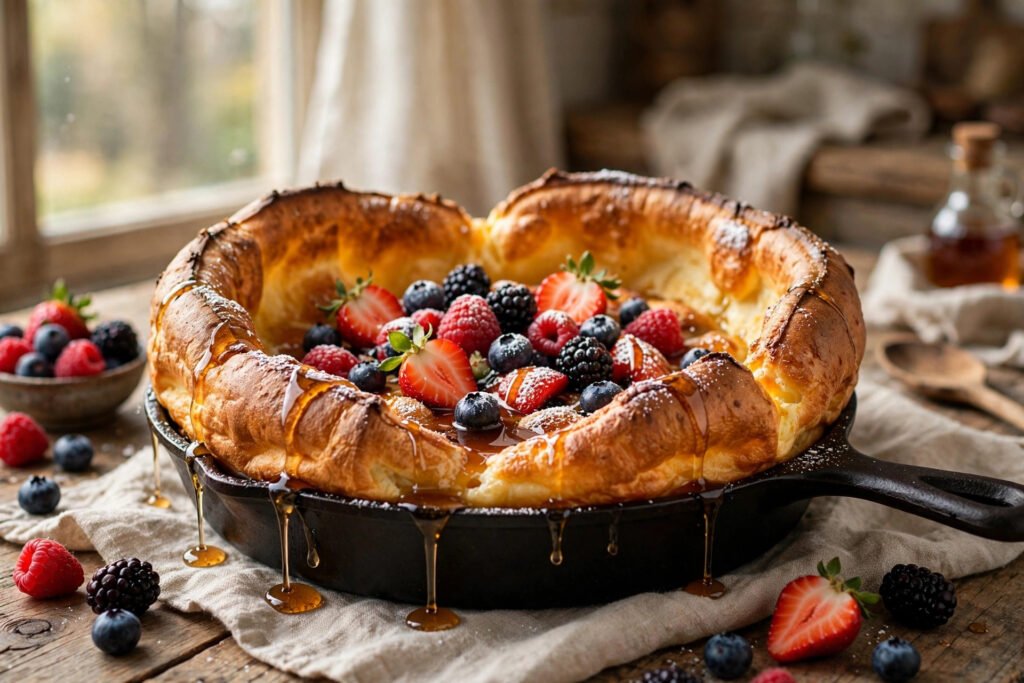

The Pancake That Puffs Like Pure Magic
The first time I made a Dutch baby, I stood in front of the oven with the light on like a child waiting for a birthday cake. Through that little glass window I watched a thin puddle of batter swell into a golden, billowy landscape with crisp, craggy edges climbing the skillet. When I pulled it out, it deflated with the softest sigh, and honestly, I think I gasped. It looked like something from a fairy tale, and it took five minutes of actual effort.
Despite the name, the Dutch baby is not Dutch at all. It is an American invention inspired by the German pfannkuchen, made famous by a Seattle restaurant in the early nineteen hundreds, where the owner’s daughter supposedly mispronounced “Deutsch” as “Dutch.” Call it what you like, because one bite of that custardy centre with its caramelised, buttery edges will make you forget the name entirely. It is part pancake, part popover, part soufflé, and completely irresistible.
What I adore most is how it turns an ordinary weekend morning into an occasion. Whisk a few pantry staples together, pour the batter into a screaming-hot skillet, and twenty minutes later you are carrying a puffy golden masterpiece to the table. My family now requests this the way other families request birthday cake, and I never argue.
Why You’ll Love This Recipe
- Show-stopping with zero skill. It looks like patisserie training, but the batter takes five minutes and a whisk.
- A texture like no other. Crisp, buttery edges give way to a soft, custardy middle between a pancake and a popover.
- One pan, easy wash-up. Everything happens in a single skillet, so breakfast lands with barely any dishes.
- Endlessly customisable. Go sweet with berries and syrup, or savoury with cheese, herbs and a fried egg.
- Ready in under thirty minutes. From fridge to table in about half an hour, faster than driving out for brunch.
Ingredients
Serves 4 — one generous skillet pancake, best shared straight from the pan.
For the batter:
- 3 large eggs, at room temperature
- 120 ml whole milk, at room temperature
- 120 g plain flour
- 2 tablespoons granulated sugar
- 1 teaspoon vanilla extract
- 1/4 teaspoon fine sea salt
- 3 tablespoons unsalted butter
For serving:
- Fresh mixed berries
- Icing sugar, for dusting
- Warm maple syrup
- Lemon wedges, optional but wonderful
Instructions
- Step 1 — Heat the oven and skillet. Put a 25 cm cast-iron or oven-safe skillet on the middle rack and preheat to 220°C (200°C fan). The pan must be ripping hot.
- Step 2 — Blend the batter. Blitz the eggs, milk, flour, sugar, vanilla and salt for twenty seconds until completely smooth, or whisk by hand until no lumps remain.
- Step 3 — Rest briefly. Let the batter sit for five minutes while the oven finishes heating. This relaxes the flour and helps it puff evenly.
- Step 4 — Melt the butter. Remove the hot skillet, add the butter and swirl until foaming, tilting to coat the base and sides.
- Step 5 — Pour and bake. Pour the batter straight into the hot, buttery skillet, return it to the oven and bake for 18 to 20 minutes without opening the door.
- Step 6 — Watch the puff. Do not peek. The batter will climb the sides and turn deeply golden with dramatic, craggy edges.
- Step 7 — Check doneness. It is ready when the edges are crisp and golden and the centre looks set rather than wet. Some deflating as it cools is normal.
- Step 8 — Top and serve. Loosen the edge with a spatula, pile on the berries, dust with icing sugar and add a squeeze of lemon.
- Step 9 — Cut and share. Slice into wedges right in the skillet and pass warm maple syrup for drizzling.
- Step 10 — Enjoy the drama. Carry the whole skillet to the table, because half the joy of a Dutch baby is the reveal.
Tips for Success
- Room-temperature eggs and milk are non-negotiable. Cold ingredients can make the batter seize and puff unevenly.
- A blender gives the smoothest batter in seconds, but vigorous hand whisking works too, as long as no flour lumps remain.
- Do not open the oven door during the first fifteen minutes. That burst of cold air can collapse the rise before it sets.
- No cast-iron skillet? Any oven-safe frying pan or round baking dish works, though cast iron gives the crispiest edges.
- Serve it the moment it comes out. A Dutch baby waits for no one and is best hot from the oven.
Serving Ideas
- Keep it classic with berries, icing sugar and maple syrup, plus a squeeze of lemon to cut the richness.
- Try a savoury version with grated gruyère, crispy bacon bits and fresh chives.
- For autumn, top with caramelised apples, a pinch of cinnamon and softly whipped cream.
- Pair with strong coffee or fresh orange juice for the easiest impressive brunch spread.
FAQs
Can I make the batter ahead of time?
Yes. Blend it the night before and keep it covered in the fridge. Whisk briefly and let it warm up for twenty minutes before baking.
Why did my Dutch baby not puff up?
The pan was probably not hot enough, the ingredients were cold, or the oven door was opened too early. Preheat the skillet in the oven for a full fifteen minutes.
Can I make it gluten-free?
You can. Swap the plain flour for a good one-to-one gluten-free blend. The texture will be slightly denser but still deliciously puffy.
Is a Dutch baby the same as a German pancake?
They are close cousins. Both are thin oven-baked pancakes, but the Dutch baby is the American evolution with its dramatic puffed edges.
Can I halve the recipe?
You can, but use a smaller skillet so the batter has enough depth to puff. A 20 cm pan works well for a two-egg version.
I hope this golden, puffy showstopper brings as much joy to your table as it brings to mine. Happy baking, and take a photo before everyone digs in.