
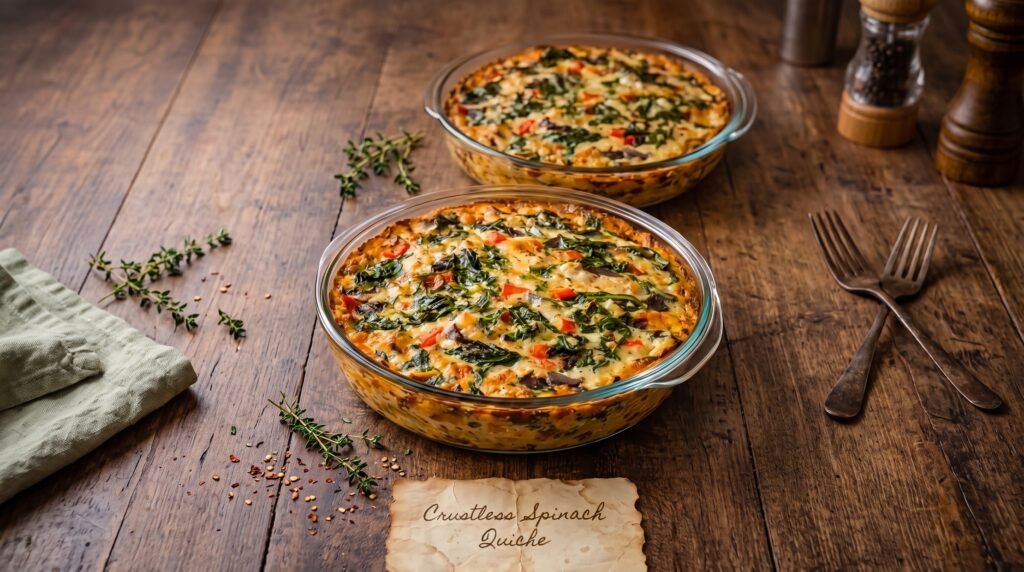

We have all been there. You wake up on a cozy Sunday morning with grand plans of a beautiful, café-worthy brunch at home. You preheat the oven, chop your vegetables, whisk your eggs with milk, and carefully assemble what you hope will be a golden, fluffy masterwork. For those of us looking to skip the hassle of rolling out pastry dough, or simply trying to cut back on heavy carbs, the crustless quiche seems like the ultimate shortcut.
But then, tragedy strikes at the cutting board. You slide your knife into the center of the baked dish, expecting a clean, custard-like slice, and instead, a small green river of watery liquid pools at the bottom of the pan. Your elegant breakfast has instantly transformed into a soggy, weeping pile of scrambled egg soup.
I lived through this culinary disappointment more times than I care to admit. For years, my crustless quiches were unpredictable. Sometimes they were dry and rubbery like an overcooked omelet; other times they were so watery they looked like they needed to be served in a bowl with a spoon. My breakthrough came when I finally decided to treat my kitchen like a laboratory and figure out why eggs, spinach, and dairy behave the way they do when baked together.
After testing dozens of egg-to-dairy ratios, experimenting with different types of pans, and ruining more than a few breakfasts, I finally cracked the code to a crustless spinach quiche that holds its shape, boasts a velvety texture, and never, ever gets watery. If you have been burned by wet, soggy egg bakes in the past, pull up a chair. I am going to share every single secret, tip, and hard-earned lesson I have gathered along the way so you can bake this perfectly every time.
Why Go Crustless Anyway
A traditional French quiche is a beautiful thing, but a classic pastry crust requires time, butter, chilling, rolling, and blind baking. If you are rushing through a busy week or trying to pull together a quick weekend brunch, you might not have a spare hour just to get the crust ready. Going crustless cuts your prep time in half and gets your breakfast into the oven much faster.
Beyond the time savings, there is the health aspect. Skipping the crust makes this dish naturally gluten-free and much lower in carbohydrates, making it highly accessible for families with diverse dietary needs. It becomes a protein-packed, vegetable-forward dish that keeps you full without leaving you feeling weighed down.
However, a crustless quiche faces a unique structural challenge. Without a sturdy pastry wall to contain the custard and absorb excess moisture, the egg mixture has to stand entirely on its own. This means your ratios must be precise, and your ingredients must be prepared with care. You cannot just throw raw, wet vegetables into a bowl of eggs and hope for the best.
The Secret Chemistry of the Egg Custard
To understand how to make a perfect quiche, we need to talk about egg science for a moment, but I promise to keep it simple. Eggs are made of proteins that resemble tiny, folded-up balls of yarn. When you apply heat, these proteins begin to unfold and bond with one another, creating a web-like structure that traps water and fat. This process is called coagulation.
If you bake eggs on their own, they cook quickly and can easily become rubbery because the protein web tightens too much, squeezing out all the moisture. To prevent this, we add dairy. The fat and water in milk or cream coat the egg proteins, slowing down the coagulation process and keeping the texture soft and velvety.
But if you add too much dairy, the protein web becomes too diluted to hold itself up, resulting in a runny custard that never sets. If you add too little dairy, you end up with a dry, spongy frittata.
For a traditional quiche with a crust, you can get away with a very rich, loose custard. But for a crustless quiche, you need a slightly sturdier structure. Through extensive trial and error, I found that the magic ratio for a crustless quiche is six large eggs to exactly one cup of dairy. This gives you enough protein to structurally support the slice while still maintaining a rich, melt-in-your-mouth mouthfeel.
Fresh Versus Frozen Spinach
One of the biggest debates in the breakfast world is whether to use fresh or frozen spinach for baking. I used to be a purist, insisting on buying huge plastic tubs of baby spinach, washing them, and cooking them down. But after years of making this dish, I am here to tell you that frozen spinach is actually superior for this specific recipe.
When spinach is harvested and frozen, the water inside its cells expands and turns into ice crystals, which naturally ruptures the tough plant cell walls. When thawed, this spinach releases its water much more easily than fresh spinach does. This means you can extract far more moisture from frozen spinach than you ever could from fresh, cooked spinach.
If you do choose to use fresh spinach, you must cook it down completely in a skillet first, let it cool, and then perform the same rigorous squeezing process that you would with frozen spinach. Raw fresh spinach contains about ninety percent water, and if you toss it directly into your egg batter, all of that water will cook out into your quiche, creating that dreaded watery puddle.
To prepare frozen spinach, thaw it completely. You can leave it in the refrigerator overnight or pop it in the microwave on the defrost setting. Once thawed, dump it into a clean kitchen towel, gather the corners to form a sack, and twist and squeeze over the sink with all your might. Keep squeezing until no more green liquid drips out. You will be shocked by how much water comes out of a single package of spinach. What started as a large pile will shrink down into a dense, dry ball of concentrated green goodness.
Choosing Your Complementary Veggies and Aromatics
While spinach is the star of the show, a great quiche needs a supporting cast of aromatics to build depth of flavor. Onions and garlic are non-negotiable in my kitchen. Sautéing them in butter until sweet and translucent creates a savory foundation that elevates the earthy notes of the spinach.
I also love adding diced red bell peppers. Not only do they add a beautiful pop of bright red color that contrasts gorgeously with the green spinach, but they also bring a subtle sweetness that balances the rich dairy and salty cheese.
If you like mushrooms, they make a fantastic addition, but they carry a warning label: mushrooms are incredibly watery. If you want to add mushrooms, you must sauté them in a hot, dry skillet until they release all their water and turn deeply golden brown before adding them to your egg mixture.
The Role of Cheese
Cheese is not just a flavor enhancer; it also plays a crucial role in the structure and texture of your crustless quiche. As the quiche bakes, the cheese melts and weaves throughout the egg mixture, helping to bind everything together as it cools.
I like to use a combination of two different cheeses to get the best of both worlds: a sharp, flavorful melting cheese and a salty, crumbly cheese.
For the melting cheese, Gruyere is the gold standard. It is nutty, creamy, and melts beautifully without becoming excessively greasy. Sharp white cheddar or Swiss cheese are excellent, easily accessible alternatives.
For the crumbly cheese, feta or goat cheese works wonders. They do not melt completely into the egg mixture; instead, they remain in soft, warm pockets, offering a tangy burst of contrast to the rich, savory custard.
Crustless Spinach Quiche Ingredients
Here is exactly what you will need to create this dish. Make sure your ingredients are at room temperature before you begin, as cold eggs and dairy can cause the butter in your sautéed veggies to seize up when mixed.
| Ingredient | Quantity | Purpose |
|---|---|---|
| Frozen chopped spinach | 10 ounces | The star green vegetable, thawed and thoroughly squeezed |
| Large eggs | 6 items | The structural base and source of rich protein |
| Heavy cream | 1/2 cup | Adds luxurious richness and prevents rubbery eggs |
| Whole milk | 1/2 cup | Thins the custard slightly while keeping it creamy |
| Unsalted butter | 1 tablespoon | For sautéing veggies and coating the baking dish |
| Yellow onion | 1 small | Finely diced for a sweet, aromatic base |
| Red bell pepper | 1/2 medium | Diced small for color and sweet contrast |
| Garlic cloves | 2 items | Minced to add warm, savory depth |
| Sharp white cheddar | 1 cup | Shredded, divided for the body and the crispy top |
| Feta cheese | 1/2 cup | Crumbled, for salty pockets of flavor |
| Salt | 1/2 teaspoon | To season and enhance all the flavors |
| Black pepper | 1/4 teaspoon | Freshly cracked for a gentle kick |
| Ground nutmeg | 1 pinch | The secret French spice that elevates egg dishes |
Step-by-Step Instructions
Now that we have gathered our ingredients and understood the science behind them, let us walk through the process step by step. Take your time, pay attention to the details, and enjoy the aromas filling your kitchen.
Prep the Oven and Your Baking Dish
Preheat your oven to 350 degrees Fahrenheit. The temperature is incredibly important here. We want a gentle, even heat. Baking eggs at too high of a temperature will cause them to puff up rapidly like a souffle and then collapse into a dense, watery mess once they cool. A moderate 350 degrees allows the custard to set slowly and evenly from the edges to the center.
Next, prepare your baking dish. You will want a nine-inch pie plate, a tart dish, or a shallow casserole dish. I highly recommend using a glass or ceramic dish, as they conduct heat more gently and evenly than metal pans.
Generously grease the entire inside of the dish with half a tablespoon of softened butter. Do not skip this step. Without a pastry crust, the eggs will stick stubbornly to the sides of the pan, making it nearly impossible to slice and serve cleanly.
Sauté the Aromatics
Melt the remaining half tablespoon of butter in a medium skillet over medium heat. Add your finely diced yellow onion and red bell pepper. Sauté these vegetables for about five to seven minutes, stirring occasionally, until the onions are soft, sweet, and translucent, and the peppers have lost their crunch.
Add the minced garlic during the last sixty seconds of cooking. Garlic burns easily, and burnt garlic will impart a bitter, unpleasant taste to your entire quiche. Cook just until you can smell the warm aroma of garlic rising from the pan, then remove the skillet from the heat and set it aside to cool slightly.
Squeeze and Prep the Spinach
While your sautéed veggies are cooling, it is time to prep your spinach. If you have not already done so, grab your thawed frozen spinach and place it in the center of a clean, lint-free kitchen towel or a few layers of heavy-duty cheesecloth.
Gather up the edges of the towel to create a bundle. Stand over your sink and twist the top of the towel to compress the spinach. Squeeze with all your strength. You will see an astonishing amount of dark green liquid pour out. Shake the spinach around inside the towel and squeeze again.
Once you are certain no more water can be extracted, open the towel. Your spinach should look like a dry, tightly compacted ball. Use your fingers to break the ball apart into loose, fluffy flecks of dry spinach leaves.
Whisk the Custard Base
In a large mixing bowl, crack your six room-temperature eggs. Whisk them vigorously for about thirty seconds until the yolks and whites are completely combined and uniform in color.
Pour in the half cup of heavy cream and half cup of whole milk. Whisk again until the mixture is smooth and pale yellow.
Now, add your seasonings. Sprinkle in the salt, freshly cracked black pepper, and that single pinch of ground nutmeg. Do not skip the nutmeg. It is an old French trick; a tiny pinch of nutmeg does not make the dish taste like dessert, but it cuts through the richness of the dairy and eggs, adding a subtle, sophisticated background note that makes people wonder what your secret ingredient is.
Assemble the Ingredients
Add your crumbled feta cheese and about three-quarters of a cup of your shredded white cheddar to the egg mixture. Reserve the remaining quarter cup of cheddar to sprinkle on top of the quiche right before it goes into the oven.
Add the dry, flaked spinach and the slightly cooled sautéed onions, bell peppers, and garlic to the bowl. Use a large spoon or spatula to gently fold everything together.
Make sure the spinach is well distributed throughout the liquid. Sometimes it likes to clump together in large balls; use your spoon to break up those clumps so that every single bite of your finished quiche has an equal distribution of vegetables and cheese.
Fill the Baking Dish
Pour the mixture into your prepared, buttered baking dish. Use your spatula to gently level the top, ensuring that the vegetables and cheese are spread out evenly across the pan and not piled up in the center.
Sprinkle the reserved quarter cup of shredded white cheddar across the top of the quiche. This will melt into a gorgeous, golden-brown crust as it bakes, giving you that satisfying, slightly crispy cheese layer on top.
For an extra touch of visual appeal, you can sprinkle a few fresh thyme leaves or a pinch of red pepper flakes on top before baking.
Bake to Golden Perfection
Carefully transfer your baking dish to the middle rack of your preheated oven. Bake for thirty-five to forty minutes.
As the quiche bakes, keep an eye on it through the oven window. It will slowly puff up around the edges, and the center will gradually transition from liquid to semi-solid.
At the thirty-five-minute mark, gently nudge the side of the baking dish. You want to see the edges set firmly, while the very center of the quiche should have a slight, gentle jiggle, similar to gelatin. If the center is completely liquid and sloshes around, it needs another five minutes. If the center is completely stiff and domed up high, it is slightly overcooked; pull it out immediately.
The top should be a beautiful golden-brown color, with bubbles of cheese toasted around the rim of the dish.
The Crucial Cooling Window
This is perhaps the hardest part of the entire process, but it is absolutely essential. Do not slice into your quiche immediately. If you cut into a boiling hot quiche straight out of the oven, the hot steam trapped inside will condense, and the delicate egg proteins will collapse, releasing their moisture onto your plate.
Let the quiche sit on a wire cooling rack on your counter for at least fifteen to twenty minutes before serving. As it cools, you will notice the puffed-up top settle back down slightly.
This cooling period allows the egg custard to fully set and firm up. It ensures that when you finally slice into it with a sharp knife, you get beautiful, clean, intact wedges that hold their shape perfectly from the plate to your fork.
Common Mistakes I Made So You Do Not Have To
My journey to the perfect quiche was paved with soggy crusts, rubbery eggs, and burnt garlic. Here are the most common pitfalls you might encounter, and exactly how to avoid them.
Squeezing the Spinach Half-Heartedly
I used to think a quick press with a spoon in a colander was enough to drain my spinach. It is not. Spinach holds onto water like a sponge. If you do not use a kitchen towel or cheesecloth to physically wring out the liquid, that water will release directly into your baking dish, diluting your custard and leaving you with a watery mess. Take the extra two minutes to squeeze it until your hands are tired.
Using Fat-Free Dairy
It can be tempting to try and save a few calories by using fat-free milk or half-and-half alternatives. Please resist this urge. As we discussed earlier, fat is what coats the egg proteins and prevents them from over-coagulating and turning rubbery. Without that fat, your quiche will have the dry, spongy texture of an over-cooked omelet. Stick to a mix of heavy cream and whole milk, or at the very least, use full-fat half-and-half.
Over-Baking the Quiche
Eggs are delicate. If you bake your quiche until the center is completely stiff and dry, the proteins will tighten up too much and begin to squeeze out their moisture, resulting in a wet plate anyway. Remember that your quiche will continue to cook from carryover heat for several minutes after you remove it from the oven. Pull it out when the center still has a slight, playful jiggle.
Using Too Many Wet Vegetables
If you decide to customize your quiche by adding other vegetables, you must cook them first. Raw zucchini, tomatoes, mushrooms, and onions are packed with water. Sauté them, roast them, or grill them to evaporate that moisture before adding them to your eggs.
Endless Customization Options
Once you master this base recipe, you can treat it as a canvas for all kinds of flavor combinations. The basic egg-to-dairy ratio remains exactly the same, but you can swap out the vegetables, cheeses, and proteins to suit your mood or empty out your refrigerator.
The Greek Garden Variant
Swap the white cheddar for crumbled feta and a handful of chopped kalamata olives. Add a teaspoon of dried oregano to the egg mixture, and fold in some diced, roasted red peppers instead of the fresh bell peppers. This version is bright, salty, and pairs beautifully with a simple side salad.
The Caramelized Onion and Gruyere Variant
If you have a little extra time on your hands, caramelize a large yellow onion in butter and a splash of olive oil over low heat for about forty-five minutes until sweet, jammy, and deep brown. Fold these sweet onions into your custard along with rich Gruyere cheese and a handful of sautéed wild mushrooms. This version is incredibly rich, savory, and sophisticated.
The Smoky Bacon and Swiss Variant
For the meat lovers, fry up six strips of thick-cut bacon until crispy. Crumble the bacon and fold it into the egg mixture along with a cup of shredded Swiss or Emmental cheese. The smoky crunch of the bacon pairs spectacularly with the earthy spinach and sweet onions.
The Spicy Jalapeno Popper Variant
If you like a bit of heat in the morning, dice up a fresh jalapeno (remove the seeds if you want a milder heat) and sauté it along with your onions. Fold in a cup of shredded pepper jack cheese and dollop a few tablespoons of softened cream cheese throughout the egg mixture before baking. It is creamy, spicy, and incredibly comforting.
Meal Prep, Storage, and Reheating Instructions
One of the reasons I make this crustless quiche almost every week is because it is an absolute dream for meal prep. It stores beautifully and can be enjoyed hot, at room temperature, or even cold straight from the fridge on busy mornings.
Storing in the Refrigerator
Once your quiche has cooled completely to room temperature, cover the baking dish tightly with plastic wrap or aluminum foil and store it in the refrigerator. It will stay fresh and delicious for up to four to five days.
If you prefer to pre-portion your breakfast, you can slice the cooled quiche into individual wedges and store them in airtight containers. This makes it incredibly easy to grab a slice, heat it up, and run out the door.
How to Reheat Without Turning It Rubbery
Reheating cooked eggs can be tricky. If you blast a slice of quiche in the microwave on high power, you run the risk of overcooking the eggs, turning them rubbery and dry.
To reheat in the microwave, place a single slice on a microwave-safe plate. Cover it loosely with a damp paper towel. This traps the steam and keeps the quiche moist. Microwave on medium power (about fifty percent) for one to two minutes, checking every thirty seconds until warmed through.
If you have a little more time, the toaster oven or conventional oven is the absolute best way to reheat your quiche. It revives that crispy cheese top and warms the custard evenly. Preheat your toaster oven to 325 degrees Fahrenheit. Place your slice of quiche on a baking sheet or a piece of foil, and bake for ten to twelve minutes until hot.
Freezing Your Quiche
Yes, you can freeze crustless quiche! However, you must do it correctly to preserve the texture.
Let the quiche cool completely in the refrigerator first. This step is crucial; if you freeze a warm quiche, large ice crystals will form inside the custard, which will break down the delicate egg protein structure and leave you with a watery mess when thawed.
Once chilled, slice the quiche into wedges. Wrap each individual wedge tightly in plastic wrap, and then wrap it again in aluminum foil to protect it from freezer burn. Place the wrapped slices in a heavy-duty freezer bag.
Your frozen quiche will keep beautifully for up to two to three months.
To reheat from frozen, thaw the slice in the refrigerator overnight. Once thawed, reheat it in the oven at 325 degrees Fahrenheit for fifteen minutes, or in the microwave using the damp paper towel method described above.
Baking Vessels: Glass, Ceramic, or Silicone
While I personally love using a classic glass pie dish because it lets me see when the bottom and sides are perfectly golden brown, you have plenty of options depending on what is in your kitchen cupboards.
Ceramic baking dishes are wonderful because they hold heat incredibly well and look gorgeous when brought straight from the oven to the dining table. Because ceramic is thicker than glass, your quiche might take an extra five minutes to bake through to the center.
Silicone baking pans are an interesting option for those who struggle with sticking. Since the pan is flexible, you can easily pop the baked quiche out once it has cooled. However, because silicone does not conduct heat as efficiently as glass or ceramic, you will not get those beautifully browned, crispy edges that make a quiche so delicious.
If you want to make individual grab-and-go portions, you can easily adapt this recipe for a standard twelve-cup muffin tin. Grease the muffin cups generously with butter, distribute your veggie and cheese mixture evenly among the cups, and pour the egg custard over the top, leaving about a quarter-inch of space at the top of each cup. Bake at 350 degrees Fahrenheit for twenty to twenty-two minutes, or until the egg cups are puffed and set in the center.
Pairing Ideas for a Complete Feast
While this crustless spinach quiche is a complete, satisfying meal on its own, it plays beautifully with a variety of side dishes if you are hosting a larger gathering.
A simple, bright green salad dressed with a zesty lemon-herb vinaigrette is the perfect counterpoint to the rich, cheesy custard. The acidity of the dressing cuts through the richness of the eggs and dairy, cleansing your palate between bites.
Fresh fruit is another fantastic pairing. A bowl of ripe berries, sliced melon, or citrus segments adds a refreshing sweetness that balances the savory, earthy tones of the spinach and onions.
If you want something a bit more substantial, crispy roasted breakfast potatoes or home fries make a wonderful side. The contrast between the soft, velvety egg custard and the crunchy, salty potatoes is absolutely heavenly.
And, of course, no brunch is complete without a warm cup of coffee, a glass of fresh orange juice, or a crisp, bubbly mimosa.
Making a crustless spinach quiche does not have to be a gamble. By understanding how egg proteins interact with dairy, and taking the time to thoroughly prep your vegetables and squeeze every last drop of water from your spinach, you can create a breakfast masterpiece that is consistently firm, velvety, and packed with incredible flavor.
It is a comforting, low-stress recipe that has earned a permanent spot in my weekly rotation. It has saved me on busy weeknights when the fridge was nearly empty, and it has wowed guests at holiday brunches. I hope it brings the same joy, convenience, and delicious satisfaction to your kitchen table. Happy cooking!