
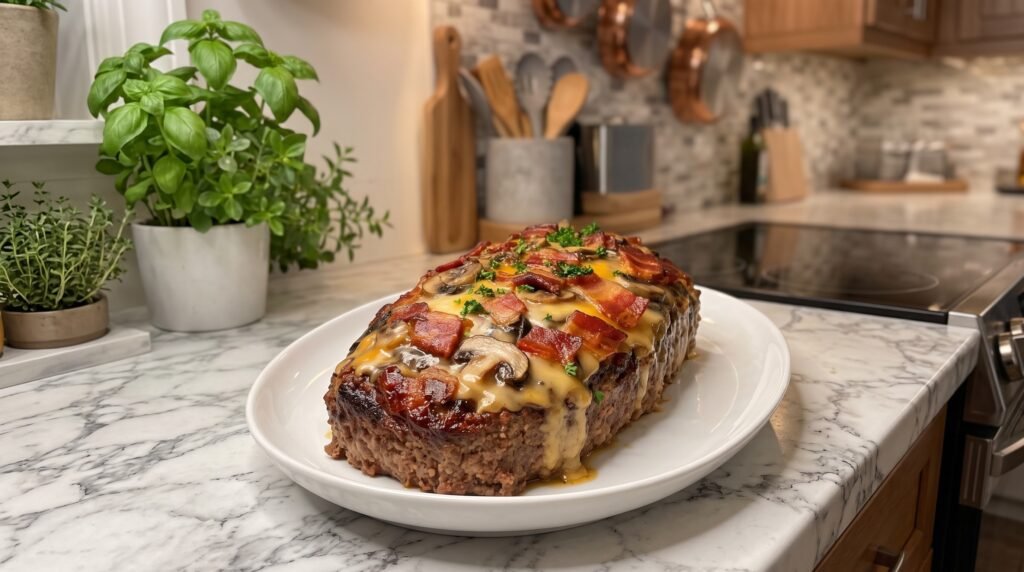

We have all been there. You walk into the kitchen, and your mom or grandma says we are having meatloaf for dinner. Instantly, your mind goes to that dry, dense, gray brick topped with a sad, sugary layer of cheap ketchup. It is the kind of meal that requires a full glass of water with every single bite just to get it down. For years, I avoided meatloaf like the absolute plague. I associated it with dry school cafeterias and tasteless weeknight dinners.
But a few years ago, my partner looked at me on a rainy Tuesday and said they were craving a classic, old-school meatloaf. My heart sank a little bit, but as a home cook who prides myself on making everything taste incredible, I took it as a personal challenge. I was not going to make just any meatloaf. I wanted to reinvent this historically tragic dish and turn it into something absolutely legendary.
I started thinking about what makes beef taste amazing. My mind immediately went to gourmet burgers. What is the best burger you can order at a high-end pub? It is almost always a mushroom Swiss burger topped with crispy bacon. The combination of earthy sautéed mushrooms, nutty melted Swiss cheese, salty bacon, and juicy beef is a flavor profile that never misses. I realized that if I could translate those exact toppings and flavors into a free-form baked meatloaf, I would have a masterpiece on my hands.
After multiple trials, a few soggy disasters, and some invaluable lessons about food science, I finally perfected the recipe. Today, I am sharing my ultimate loaded bacon mushroom Swiss meatloaf with you. This is not your grandma's dry meatloaf. This is a incredibly juicy, deeply savory, umami-packed showstopper that will convince even the harshest meatloaf skeptics to ask for seconds.
The Secret to an Incredibly Juicy Meatloaf
Before we get into the actual ingredients and steps, we need to talk about the science of meatloaf. The biggest mistake people make is treating meatloaf like a giant hamburger patty. If you just press ground beef together and bake it, it will dry out, shrink, and become tough. To prevent this, we must use a culinary secret called a panade.
A panade is a paste made from starch and liquid that is mixed into ground meat. When you cook meat, the proteins coil up and squeeze out their natural moisture. This is why a burger shrinks when you cook it. But when you mix a starch, like breadcrumbs or fresh bread soaked in milk, into the meat, those starch molecules physically get in the way of the protein chains. They prevent the proteins from bonding too tightly together, which keeps the meat incredibly tender. Furthermore, the starch acts like a sponge, absorbing and holding onto the juices as the meat cooks.
For this recipe, I highly recommend using panko breadcrumbs soaked in whole milk. Panko has a lighter, airier texture than traditional fine breadcrumbs, which prevents the meatloaf from feeling too heavy or dense. If you have stale white bread on hand, you can tear it into tiny pieces and soak it in milk instead. Either way, do not skip this step. It is the absolute key to achieving a melt-in-your-mouth texture.
The Meat Ratio Matters
Another crucial factor in meatloaf success is the fat content of your meat. If you use 90/10 or 95/5 extra lean ground beef, your meatloaf will be dry and crumbly. Fat equals flavor, and more importantly, fat equals moisture.
I prefer to use an 80/20 blend of ground beef. This gives you the perfect balance of rich beefy flavor and enough fat to keep everything juicy. If you want to take your meatloaf to the absolute next level, you can use a mix of ground beef and ground pork. Ground pork has a milder flavor but a wonderfully soft texture and great fat content. A seventy-thirty split of beef to pork is my personal gold standard for meatloaf. For this specific recipe, we will stick to a high-quality 80/20 ground beef, but feel free to experiment with a beef and pork blend if you like.
The Mushroom and Bacon Toppings
Let us talk about the toppings because they are the star of the show. We are not just tossing raw mushrooms and bacon on top of the meat and hoping for the best. That is a recipe for a greasy, watery disaster.
Mushrooms are mostly made of water. If you put raw sliced mushrooms on top of your meatloaf, they will release all their liquid as they cook. This moisture will pool on top of your meat, making the crust soggy and preventing the cheese from melting properly. To avoid this, we must sauté our mushrooms beforehand. Sautéing them in butter with a touch of garlic and a splash of Worcestershire sauce caramelizes their natural sugars, concentrates their earthy flavor, and cooks off all that excess water.
The same rule applies to the bacon. If you drape raw bacon over a raw meatloaf, the bacon will cook, but it will release a massive amount of grease directly into the meat. The bacon on top will also struggle to get truly crispy because it is sitting on a moist surface. My trick is to chop the bacon into small pieces and cook it in a skillet until it is about seventy percent done. It should be lightly browned but still flexible. We then drain the grease and use these semi-crispy bacon bits to top our meatloaf during the final stages of baking. This ensures that the bacon gets perfectly crispy and caramelized in the oven without making the meatloaf greasy.
Choosing the Perfect Cheese
For a mushroom Swiss profile, Swiss cheese is the obvious choice. Its mild, sweet, and nutty flavor pairs beautifully with the earthy mushrooms and salty bacon. However, Swiss cheese does not always melt as smoothly as we might want. It can sometimes become slightly oily or rubbery if overcooked.
To solve this, I like to use a combination of Swiss cheese and shredded Monterey Jack, Provolone, or mild white Cheddar. Monterey Jack melts like an absolute dream and adds a creamy texture that helps bind the mushrooms and bacon to the top of the meatloaf. Mixing grated Swiss cheese with a good melting cheese gives you the absolute best of both worlds: incredible flavor and a gorgeous, gooey melt.
Ingredients for the Ultimate Meatloaf
Here is everything you will need to make this incredible dish. Try to use fresh ingredients wherever possible, especially when it comes to the garlic and herbs.
| Ingredient | Amount | Notes |
|---|---|---|
| Ground beef (80/20 blend) | 2 pounds | High-quality, freshly ground is best |
| Panko breadcrumbs | 1 cup | Gives a lighter texture than regular breadcrumbs |
| Whole milk | 1/2 cup | For making the panade |
| Eggs | 2 large | Lightly beaten, acts as a binder |
| Yellow onion | 1 medium | Finely minced or grated |
| Garlic cloves | 4 cloves | Finely minced |
| Worcestershire sauce | 2 tablespoons | Divided (one for meat, one for mushrooms) |
| Soy sauce | 1 tablespoon | Adds deep savory umami flavor |
| Dijon mustard | 1 tablespoon | Adds a nice tangy kick |
| Fresh parsley | 1/4 cup | Finely chopped, divided |
| Dried thyme | 1 teaspoon | Classic herb flavor for beef |
| Kosher salt | 1.5 teaspoons | Adjust to taste |
| Black pepper | 1 teaspoon | Freshly cracked |
| Bacon | 6 strips | Cut into half-inch pieces |
| Cremini mushrooms | 8 ounces | Cleaned and sliced |
| Butter | 2 tablespoons | For sautéing mushrooms |
| Swiss cheese | 1 cup | Freshly grated |
| Monterey Jack cheese | 1 cup | Freshly grated |
Step-by-Step Instructions
Now that we have our ingredients ready, let us walk through the process of putting this masterpiece together. Read through the steps completely before you start cooking so you know exactly what to expect.
Step 1: Prep the Oven and Pan
First, preheat your oven to 375 degrees Fahrenheit. While the oven is heating up, prepare your baking vessel.
I strongly recommend baking your meatloaf free-form on a rimmed baking sheet lined with aluminum foil or parchment paper rather than packing it into a traditional loaf pan. When you cook meatloaf in a loaf pan, the meat essentially boils in its own grease and steam. You miss out on all those delicious, crispy caramelized edges on the sides of the loaf. Baking it free-form on a sheet pan allows hot air to circulate all the way around the meat, creating a beautiful crust on the outside while keeping the inside tender.
Lightly spray the foil or parchment paper with non-stick cooking spray and set the baking sheet aside.
Step 2: Sauté the Aromatics
One of my biggest pet peeves is biting into a slice of meatloaf and finding crunchy, raw chunks of onion. Raw onions do not have enough time to cook fully inside a dense meatloaf, and they release a harsh, sulfurous flavor. To prevent this, we are going to sauté our aromatics first.
Place a skillet over medium heat and add a tablespoon of olive oil or butter. Once hot, add your finely minced onion. Cook the onion for about five to seven minutes, stirring frequently, until it is soft, translucent, and sweet.
Add the minced garlic, dried thyme, and a pinch of salt to the skillet. Cook for another sixty seconds until you can smell the garlic and herbs. Be careful not to burn the garlic, as burnt garlic turns bitter. Remove the skillet from the heat and let the mixture cool down for a few minutes. Adding hot ingredients directly to raw ground beef can partially cook the meat proteins and ruin the texture of your loaf.
Step 3: Make the Panade and Mix the Base
In a large mixing bowl, combine your panko breadcrumbs and whole milk. Stir them together and let the mixture sit for about five minutes. The breadcrumbs will absorb the milk and turn into a soft, wet paste.
Once your panade is ready, add the lightly beaten eggs, Worcestershire sauce, soy sauce, Dijon mustard, cooled onion and garlic mixture, half of the fresh parsley, kosher salt, and freshly cracked black pepper to the bowl. Whisk everything together until you have a smooth, highly seasoned liquid base.
By mixing all of your seasonings and wet ingredients together before adding the meat, you ensure that the flavors will be evenly distributed throughout the entire meatloaf without having to overwork the beef.
Step 4: Combine with the Ground Beef
Add your ground beef to the bowl with the seasoned mixture. Now, pay close attention because this is the most critical part of the entire process: do not overmix the meat.
If you squeeze, mash, or knead the ground beef like bread dough, you will break down the meat fibers and create a dense, rubbery, dry meatloaf. Instead, use your hands like a gentle claw. Gently fold and toss the meat with the wet mixture until it is just combined. It is perfectly fine if the mixture looks a bit loose; the eggs and breadcrumb paste will hold it together beautifully as it bakes.
Step 5: Shape and Bake the Loaf
Transfer the meat mixture onto your prepared baking sheet. Gently shape it with your hands into a uniform loaf shape, roughly nine inches long, five inches wide, and about two inches thick. Try to make the top of the loaf relatively flat rather than rounded, as this will make it much easier to pile on our toppings later.
Place the baking sheet in the preheated oven and bake for forty-five minutes.
Step 6: Prepare the Mushrooms and Bacon
While the meatloaf is doing its first bake, we can prepare our delicious toppings.
In a large skillet over medium-high heat, add the chopped bacon pieces. Cook them, stirring occasionally, until the bacon has rendered its fat and is lightly browned but still soft and flexible. Do not cook it until it is completely crispy, as it will continue to cook on top of the meatloaf. Use a slotted spoon to transfer the cooked bacon to a plate lined with paper towels to drain. Pour off most of the bacon grease from the skillet, leaving about one tablespoon behind.
Place the skillet back on medium-high heat and add two tablespoons of butter. Once the butter is melted and bubbling, toss in your sliced cremini mushrooms. Spread them out in a single layer and let them sear without moving them for two to three minutes. This helps develop a beautiful brown crust on the mushrooms, which enhances their savory flavor.
Stir the mushrooms and continue to cook for another five minutes until they have released their liquid and shrunk significantly. Splash in a tablespoon of Worcestershire sauce and a pinch of salt and pepper. Cook for one more minute until the liquid has evaporated and the mushrooms are glossy and caramelized. Remove from the heat and set aside.
Step 7: Load Up the Meatloaf
After forty-five minutes of baking, carefully remove the meatloaf from the oven. You will notice some juices and fat have pooled on the baking sheet around the base of the loaf. This is completely normal. If there is a lot of excess liquid, you can gently tilt the pan and use a spoon or paper towel to remove some of it.
Now comes the fun part. Sprinkle half of your grated Swiss and Monterey Jack cheese mixture evenly over the top of the hot meatloaf. The cheese will start to melt immediately, acting as a delicious glue.
Next, spoon the warm caramelized mushrooms over the cheese layer, spreading them out evenly.
Pile the semi-cooked bacon pieces on top of the mushrooms.
Finally, blanket everything with the remaining Swiss and Monterey Jack cheese. This top layer of cheese will melt down over the bacon and mushrooms, holding everything together in a glorious, gooey crown.
Step 8: The Final Bake and Melt
Return the loaded meatloaf to the oven. Bake for an additional fifteen minutes, or until the cheese is completely melted, bubbly, and starting to turn golden brown around the edges.
If you want your cheese and bacon extra crispy, you can turn your oven to broil for the last two minutes of cooking. If you do this, watch it like a hawk. The line between perfectly melted cheese and burnt ruin is incredibly thin under a hot broiler.
To ensure your meatloaf is fully cooked, you can insert an instant-read meat thermometer into the thickest part of the center. It should read at least 160 degrees Fahrenheit.
Once cooked, remove the meatloaf from the oven and garnish it generously with the remaining fresh chopped parsley. The bright green parsley adds a beautiful pop of color and a fresh, clean flavor that cuts through the richness of the beef, cheese, and bacon.
Step 9: The Golden Rule of Resting
I know it smells absolutely incredible in your kitchen right now. I know you want to grab a knife and carve into that bubbling masterpiece immediately. But please, resist the urge.
If you slice a hot meatloaf immediately out of the oven, all those delicious, savory juices will run out onto the board, leaving you with dry meat. Additionally, the structure of the loaf needs time to firm up as it cools slightly. If you cut it now, your beautiful slices will crumble and fall apart.
Let the meatloaf rest on the baking sheet for at least ten to fifteen minutes before slicing. This allows the juices to redistribute throughout the meat and ensures you get clean, beautiful slices that hold their shape perfectly.
Common Mistakes to Avoid
Even with a foolproof recipe, a few common pitfalls can derail your meatloaf journey. Here are the most frequent mistakes I see people make, along with how to avoid them.
Using extra-lean meat: As mentioned earlier, fat is essential for moisture and flavor. Avoid using meat that is leaner than eighty-twenty. If you must use lean beef, mix in a good amount of ground pork to compensate for the lack of fat.
Overmixing the meat: Treat your ground beef gently. The more you mix it, the denser it will become. Use a light hand and stop mixing as soon as the ingredients are combined.
Baking in a deep loaf pan: If you want those crispy, caramelized outer edges, skip the loaf pan. Use a flat baking sheet instead. It completely transforms the texture of the crust.
Skipping the resting period: Cutting the meatloaf too early is the number one reason slices fall apart. Give it ten to fifteen minutes of rest time. Your patience will be rewarded.
Not seasoning the meat enough: Meatloaf requires a surprising amount of seasoning because of the breadcrumbs and milk. If you are ever unsure about your seasoning levels, pinch off a tiny piece of the raw meat mixture and fry it up in a small skillet. Taste it, and adjust the salt and spices in the main bowl accordingly before shaping your loaf.
Why This Recipe Works So Well
This loaded bacon mushroom Swiss meatloaf is a favorite in my house for several reasons.
First, it is incredibly balanced. The rich, savory beef is paired with the earthy sweetness of sautéed mushrooms, the salty crunch of bacon, and the creamy, nutty melt of Swiss and Monterey Jack cheeses.
Second, the texture is phenomenal. Thanks to the panade method, the meat remains tender and juicy throughout the baking process. The contrasts in texture, from the crispy bacon bits to the soft mushrooms and gooey cheese, make every bite exciting.
Finally, it is a complete comfort food experience. It feels elevated enough for a Sunday family dinner or hosting friends, yet simple enough to prepare on a busy weeknight. It takes the familiar comfort of a classic meatloaf and elevates it to restaurant-quality heights.
How to Store and Reheat Leftovers
If you have any leftovers, you are in luck. In my opinion, leftover meatloaf might actually be better than fresh meatloaf.
Store any leftover slices in an airtight container in the refrigerator for up to three to four days.
To reheat, avoid the microwave if possible. The microwave can make the meat rubbery and dry. Instead, heat a skillet over medium heat with a tiny splash of oil or butter. Add a slice of meatloaf and cook for three to four minutes per side until it is heated through and the edges are crispy. This revives the crispy crust and melts the cheese beautifully.
Alternatively, you can place the slices on a baking sheet, cover them loosely with aluminum foil to prevent drying, and warm them in a 350-degree oven for ten to fifteen minutes.
The Legendary Next-Day Meatloaf Sandwich
You cannot talk about leftover meatloaf without mentioning the classic meatloaf sandwich. It is an art form in itself.
Take two thick slices of high-quality sourdough or brioche bread. Spread a thin layer of mayonnaise on one side and a bit of Dijon mustard or spicy aioli on the other.
Pan-sear a slice of your leftover loaded meatloaf until it is hot and crispy on both sides. Place the warm meatloaf on the bread, top it with a slice of fresh Swiss cheese, and let it melt. Add some crisp butter lettuce and a couple of pickles if you like.
It is, hands down, one of the best sandwiches you will ever eat. Sometimes I make a double batch of this meatloaf just to guarantee I have enough leftovers for sandwiches the next day.
Side Dishes to Complete the Meal
To turn this loaded meatloaf into a complete feast, you need the right side dishes.
Garlic mashed potatoes are a classic pairing. The creamy potatoes are the perfect vehicle for any savory juices that run off the meatloaf.
Roasted green beans or asparagus add a nice, crisp-tender green element that cuts through the richness of the beef, bacon, and cheese.
A simple, crisp wedge salad with a tangy blue cheese or vinaigrette dressing is also fantastic. The acidity of the dressing cleanses your palate between bites of the rich meatloaf.
If you want to keep the mushroom theme going, a side of wild rice pilaf with herbs is another excellent option.
Final Thoughts
Making great food does not require fancy ingredients or complicated culinary degrees. It is all about taking classic flavor combinations, understanding a few basic rules of food science, and putting in a little bit of extra love and attention to detail.
By sautéing your aromatics, using a panade, pre-cooking your toppings, and choosing the right baking method, you can transform a historically dry weeknight staple into a meal that your family will beg you to make week after week.
Give this loaded bacon mushroom Swiss meatloaf a try. Put on your favorite music, take your time preparing the ingredients, and enjoy the process of creating something truly delicious from scratch. Your kitchen will smell absolutely incredible, and your dinner table will be filled with very happy faces. Happy cooking, everyone!