
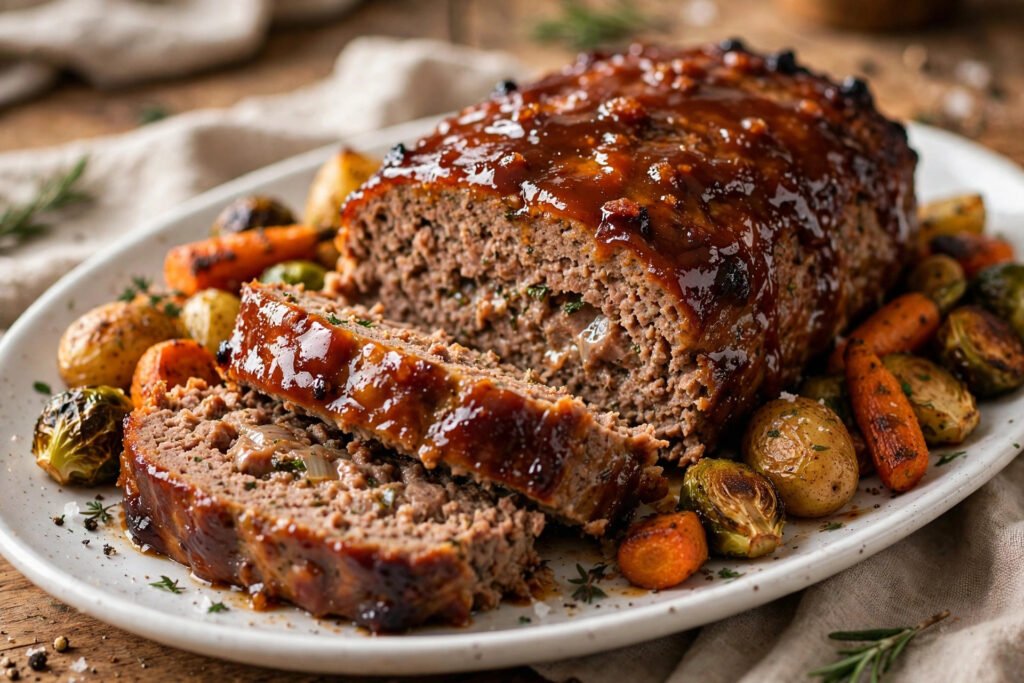

Classic Glazed Meatloaf — The Recipe My Family Fights Over
Every family has one recipe that starts a friendly argument at the table. In my house, it’s this meatloaf. My husband insists the end slices are best — all caramelized glaze and crispy edge. My son loudly claims the soft middle slice, the one that soaks up the pan juices. Last Sunday they actually negotiated a trade.
This one blew up on our Luna Cooks page. I shared the reel on a quiet Thursday, and by morning it had 5,500 views and a comment thread full of meatloaf memories. Meatloaf is having a moment, and I think I know why. In a world of complicated weeknight dinners, there’s something deeply comforting about a dish that asks so little and gives back so much.
Why You’ll Love This Recipe
This is not dry cafeteria meatloaf. It’s juicy, slices cleanly, and the glaze caramelizes into a sticky mahogany crust:
- Foolproof texture: the milk-soaked breadcrumb panade keeps every slice moist — never dense or dry.
- That glaze: ketchup, brown sugar, and vinegar reduce into a glossy topping you’ll want to eat with a spoon.
- Pantry ingredients: nothing fancy, nothing you have to hunt for.
- Feeds a crowd cheaply: two pounds of meat stretch into 8 hearty servings.
- Legendary leftovers: cold meatloaf sandwiches the next day might beat the original dinner.
Ingredients
Makes one large loaf serving 8. Make the full recipe even for a small crowd.
- 1 1/2 pounds ground beef (80/20)
- 1/2 pound ground pork
- 1 cup plain breadcrumbs
- 3/4 cup whole milk
- 2 large eggs, lightly beaten
- 1 medium yellow onion, finely diced
- 3 cloves garlic, minced
- 2 tablespoons Worcestershire sauce
- 2 tablespoons yellow mustard
- 1 teaspoon kosher salt
- 1 teaspoon black pepper
- 1 teaspoon dried thyme
- 1/2 teaspoon smoked paprika
For the glaze:
- 3/4 cup ketchup
- 1/4 cup packed brown sugar
- 2 tablespoons apple cider vinegar
- 1 teaspoon Worcestershire sauce
- 1/2 teaspoon garlic powder
Instructions
- Heat the oven to 350°F (175°C). Line a rimmed baking sheet with foil, and set a wire rack on top if you have one — it lets fat drip away and browns every surface.
- Make the panade. Stir the breadcrumbs and milk in a large bowl and let sit 5 minutes until soft and mushy. This is what separates juicy meatloaf from a meat brick — don’t skip it.
- Sauté the onion. Cook the diced onion in a drizzle of oil 4 to 5 minutes until soft, then add the garlic for 1 minute more. Cool a few minutes. Raw onion stays sharp; a quick sauté turns it sweet and mellow.
- Combine gently. Add the beef, pork, eggs, Worcestershire, mustard, salt, pepper, thyme, paprika, and cooled onion to the panade. Mix with your hands just until combined. Overmixing is the number one cause of tough meatloaf.
- Shape the loaf. Form a loaf about 9 inches long, 5 inches wide, and 3 inches tall on the baking sheet. Don’t pack it tightly — a loose shape bakes up more tender.
- Mix the glaze. Whisk the ketchup, brown sugar, vinegar, Worcestershire, and garlic powder until smooth.
- Glaze and bake. Spread half the glaze over the top and sides and bake 40 minutes.
- Glaze again. Brush on the rest — be generous — and bake 20 to 25 minutes more, 60 to 65 minutes total. Two rounds is the trick: the first bakes into the meat, the second goes on glossy and sticky.
- Check doneness. It’s ready when a thermometer in the thickest part reads 160°F and the glaze is dark and caramelized at the edges.
- Rest, then slice. Rest on a cutting board 10 to 15 minutes — cutting too soon lets the juices run out. Slice thick and serve with mashed potatoes, green beans, and extra glaze.
Pro Tips for the Best Results
- Use the beef-pork combo. All-beef can taste flat; the pork adds fat and a subtle sweetness that makes the loaf richer.
- Hands off the meat. Mix gently, shape loosely. Every extra squeeze tightens the proteins toward doorstop territory.
- Trust the thermometer. Guessing is how meatloaf ends up pink inside or baked to dust. Pull at 160°F — carryover heat does the rest.
- Free-form beats a loaf pan. A pan traps the meat in its grease; free-forming gives a caramelized crust on every surface.
- Save the drippings. The caramelized bits on the foil are gold — whisk a spoonful into mashed potatoes or thin with broth for a quick pan sauce.
Variations
Bacon-wrapped: lay 8 to 10 strips of bacon in a lattice over the loaf before the first glaze. It crisps and bastes the meatloaf as it cooks.
Italian style: swap the ketchup glaze for marinara, add 1/2 cup Parmesan and 2 teaspoons Italian seasoning to the meat, and top with mozzarella for the last 10 minutes.
Storage & Reheating
Fridge: leftovers keep airtight up to 4 days. Freezer: wrap the cooled loaf or slices in plastic then foil and freeze up to 3 months; thaw overnight. It also freezes well unbaked — add 15 to 20 minutes to the bake. Reheat: warm slices in a 325°F oven covered with foil for 15 minutes, or crisp them in a covered skillet — I prefer the skillet for the edges. And make at least one cold meatloaf sandwich on white bread with mayo.
Nutrition Estimate
Per serving (1 thick slice): roughly 420 calories, 28g protein, 22g carbs, 24g fat.
Frequently Asked Questions
Why did my meatloaf fall apart when I sliced it?
Three usual suspects: not enough binder, underbaking, or slicing too soon. Use the full breadcrumbs and eggs, bake to 160°F, and rest the full 10 to 15 minutes.
Can I make it without breadcrumbs?
Yes — 3/4 cup rolled oats is the classic swap. Crackers, panko, or cooked rice work too. Just soak the starch in the milk first.
My glaze burned. What happened?
Brown sugar caramelizes fast if the oven runs hot. Bake on the center rack, and tent loosely with foil for the last 15 minutes if it’s browning too quickly.
Can I prep this the night before?
Absolutely. Shape the loaf, cover tightly, and refrigerate overnight. Add the glaze just before baking and give it 5 to 10 extra minutes since it’s starting cold.
That’s the loaf that started a family debate and then took over my comments section. Make it on a Sunday, pile the mashed potatoes high, and hold your own end-slice debate.