
We have all been there. It is a big anniversary, a landmark birthday, or maybe you just want to show someone how much you care through a home-cooked meal. You walk up to the seafood counter, sweat slightly as you look at the price per pound, and tentatively ask the fishmonger for four large lobster tails. You drive home with this precious cargo wrapped in butcher paper, feeling like a high-end chef, only to face a sudden wave of sheer panic when you stand in front of your stove.
How do I cut these open? What if I overcook them and they turn into expensive rubber erasers? How do I get that beautiful restaurant look where the meat sits perfectly on top of the shell?
My first attempt at cooking lobster tails was an absolute disaster. I was trying to make a romantic dinner for my partner. I decided to boil them because a random recipe online told me it was the easiest method. I did not butterfly them, I did not season them properly, and I completely lost track of time. The result was a tragic plate of curled-up, greyish, squeaky meat that tasted like a salt-soaked rubber band. We ended up ordering pizza, and my wallet wept for days.
Since that fateful night, I have made it my mission to master seafood at home. I spent years experimenting with grilling, broiling, poaching, and baking. Through countless trials, errors, and kitchen messes, I discovered that baking lobster tails in a pool of rich garlic herb butter is hands down the most foolproof, delicious, and spectacular way to prepare them.
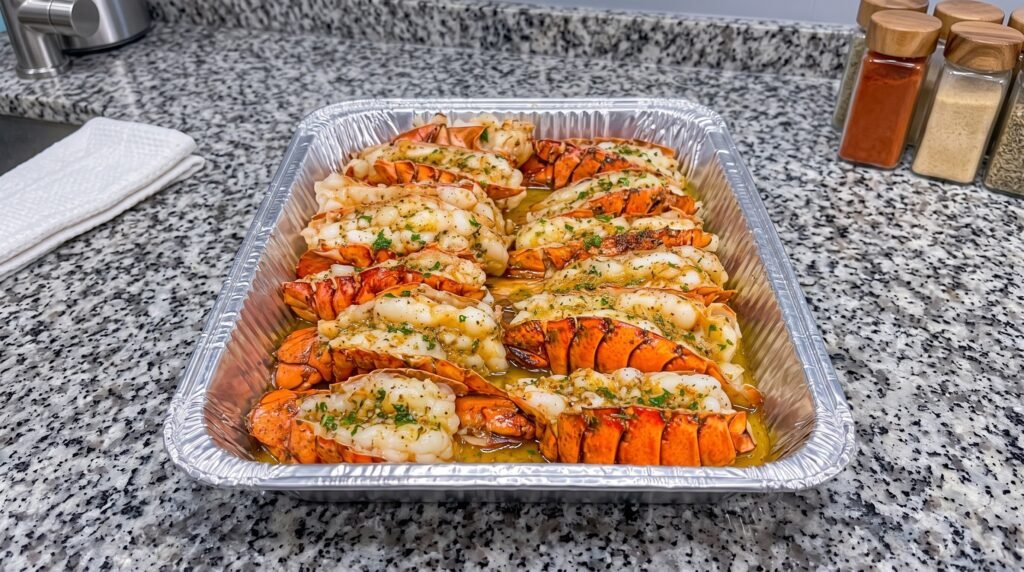
Baking allows the heat to circulate gently around the meat. When you pair this gentle heat with a continuous bath of melted butter, the lobster stays incredibly succulent, tender, and sweet. Even better, it looks absolutely stunning when served in a simple foil baking pan, surrounded by a golden lake of seasoned butter.
Here is my complete, step-by-step guide to making perfect garlic butter baked lobster tails at home. I will share every tip, trick, and lesson I learned the hard way so you can skip the learning curve and nail this recipe on your very first try.
Cold Water vs Warm Water: The Seafood Counter Trap
Before you even touch a kitchen knife, you need to buy the right ingredients. This is where most home cooks make their very first mistake, often without realizing it.
When you stand at the seafood counter, you will usually see two types of lobster tails: cold-water lobster tails and warm-water lobster tails. Warm-water tails are often significantly cheaper, which makes them highly tempting. However, I strongly advise you to avoid them if you want a truly premium dining experience.
Cold-water lobsters live in the icy depths of the North Atlantic, particularly around Maine and Canada. Because they live in cold temperatures, their meat grows slowly, resulting in a dense, firm texture and an incredibly sweet, clean flavor. When cooked, cold-water lobster meat holds its shape beautifully and melts in your mouth.
Warm-water lobsters, usually sourced from Florida, the Caribbean, or Latin America, live in warm temperatures. Their meat tends to be much softer, mushier, and sometimes has a subtle fishy or metallic aftertaste. When you bake warm-water lobster, it can easily disintegrate or turn stringy.
Always ask your fishmonger where the lobsters came from. If they do not know, look at the shells. Cold-water tails usually have a darker, greenish-brown or deep blue-black shell. Warm-water tails often have spotted patterns, yellowish bands, or a lighter greenish-grey hue. Spend the extra few dollars on cold-water tails. Your tastebuds will thank you.
The Anatomy of a Lobster Tail and How to Butterfly It
Butterflying a lobster tail is the secret to getting that gorgeous restaurant-quality presentation. It exposes the meat directly to the heat and the seasoned butter, ensuring even cooking. It also makes the lobster incredibly easy to eat once it is on the plate.
The first time I tried to butterfly a lobster tail, I ended up with a shredded mess of shell shards and mangled meat. I was using a dull kitchen knife, which is a recipe for disaster. The secret tool you need is a sturdy pair of kitchen shears or heavy-duty clean scissors.
Start by placing the lobster tail flat on your cutting board, with the hard top shell facing up and the fan tail pointing away from you. Hold the tail firmly with your non-dominant hand.
Insert the bottom blade of your kitchen shears just under the top shell, keeping it close to the shell to avoid cutting deep into the meat. Carefully snip down the center of the shell, moving toward the tail fan. Stop cutting right before you reach the very end of the tail fan. You want to leave the fan intact.
Once you have made the cut, gently press down on the shell with both thumbs to crack the ribs underneath. You will hear a satisfying pop. This cracking action loosens the meat from the bottom of the shell and opens up the top of the shell like a book.
Now, slip your fingers underneath the meat through the split you just made. Gently separate the meat from the bottom and sides of the shell, keeping it attached at the very base near the tail fan.
Carefully lift the meat upward through the split in the shell, laying it down on top of the closed shell halves. Press the shell halves back together underneath the meat, so the meat rests on top of its own shell like a pillow.
At this point, you might see a dark line running down the center of the meat. This is the vein. Use a paper towel or the tip of a paring knife to gently scrape it away and discard it. Your lobster is now beautifully butterflied and ready for the butter bath.
The Ultimate Garlic Butter Herb Glaze
The lobster is the canvas, but the garlic butter is the masterpiece. You want a sauce that enhances the natural sweetness of the seafood without overpowering it.
I always use unsalted butter for this recipe. Different brands of salted butter have wildly different sodium levels, and there is nothing worse than spending a fortune on lobster only to make it taste like salt water. By using unsalted butter, you retain total control over the seasoning.
I also highly recommend using fresh garlic cloves rather than the pre-minced stuff in a jar. Jarred garlic has an acidic, preserved taste that can ruin the delicate sweetness of the lobster. Take the extra two minutes to finely mince or grate fresh garlic.
Here is the perfect ingredient list for a batch of four to six lobster tails.
| Ingredient | Amount | Purpose |
|---|---|---|
| Cold-water lobster tails | 4 to 6 tails (6-8 ounces each) | The main protein of the dish |
| Unsalted butter | 1 cup (2 sticks) | The rich base for the basting sauce |
| Fresh garlic | 6 cloves, finely minced | Provides a deep, aromatic flavor |
| Fresh lemon juice | 2 tablespoons | Adds acidity to balance the rich butter |
| Fresh flat-leaf parsley | 3 tablespoons, finely chopped | Adds fresh herbal notes and green color |
| Kosher salt | 1 teaspoon | Enhances the natural sweetness |
| Freshly cracked black pepper | 1/2 teaspoon | Adds a subtle warmth |
| Smoked paprika | 1/2 teaspoon | Gives a gorgeous golden color to the baked meat |
Step-by-Step Cooking Instructions
Now that your ingredients are prepped and your lobster tails are beautifully butterflied, it is time to cook. Follow these steps carefully to ensure your lobster comes out juicy, tender, and perfectly seasoned.
Step 1: Preheat your oven to 400 degrees Fahrenheit. If you have a convection oven, you can set it to 375 degrees Fahrenheit. You want a moderately hot oven to cook the meat quickly without drying out the edges.
Step 2: Prepare your baking pan. I love using a disposable aluminum foil baking pan for this recipe, just like the one in the reference image. Not only does it make cleanup an absolute breeze, but the thin aluminum conducts heat rapidly and allows the butter to pool perfectly around the bottom of the shells. If you do not have a foil pan, a heavy rimmed baking sheet or a cast-iron skillet works wonderfully too.
Step 3: Arrange the butterflied lobster tails in the pan. Position them close together but not tightly packed. They should sit flat, with the meat facing upward.
Step 4: Make the garlic herb butter. In a small saucepan over low heat, melt the unsalted butter. Once melted, add the finely minced garlic and cook for about 1 to 2 minutes, stirring constantly. You want the garlic to become fragrant and soft, but do not let it brown. Browned garlic tastes bitter and will ruin the delicate sauce. Remove the pan from the heat. Stir in the fresh lemon juice, kosher salt, black pepper, smoked paprika, and finely chopped fresh parsley.
Step 5: Baste the lobster. Using a pastry brush or a large spoon, generously coat the lobster meat with the garlic butter mixture. Be sure to get the butter into all the nooks and crannies of the meat. Pour the remaining butter directly into the bottom of the baking pan around the lobster tails. This creates a luxurious shallow bath of butter that will braise the bottom of the tails as they bake.
Step 6: Bake the lobster. Place the pan on the middle rack of your preheated oven. The cooking time will vary depending on the size of your lobster tails. A good rule of thumb is to bake for about 1 to 1.5 minutes per ounce of individual tail weight. For 6-ounce tails, bake for 7 to 9 minutes. For larger 8-ounce tails, bake for 10 to 12 minutes.
Step 7: Check the temperature. This is the single most important step in the entire process. Do not guess if the lobster is done. Use an instant-read digital meat thermometer. Insert the probe into the thickest part of the lobster meat. You are looking for an internal temperature of 135 to 140 degrees Fahrenheit. At this temperature, the meat will be opaque, white, and incredibly tender. If you let it go past 145 degrees, the proteins will seize up, and the lobster will become tough and rubbery.
Step 8: Garnish and serve. Remove the pan from the oven. The butter in the bottom of the pan should be bubbling gently, infused with the juices of the lobster. Spoon some of the hot garlic butter from the pan over the cooked meat once more. Garnish with a sprinkle of fresh parsley and serve immediately with extra lemon wedges on the side.
Crucial Tools for Seafood Success
Cooking lobster does not require a kitchen filled with expensive gadgets, but having a few specific, high-quality tools will make the process infinitely easier and more successful.
First, invest in a good pair of kitchen shears. Do not try to use cheap paper scissors from your office drawer. You need shears with thick, stainless-steel blades that can easily cut through tough seafood shells without slipping. This prevents accidents and ensures clean cuts.
Second, a reliable digital instant-read thermometer is non-negotiable. Seafood cooks incredibly fast, and the window between perfectly cooked and overcooked is often less than sixty seconds. A digital thermometer gives you an accurate reading in under three seconds, taking all the guesswork out of the equation.
Third, a high-quality pastry brush is incredibly useful for applying the butter glaze. A silicone pastry brush is my favorite because it is easy to clean, does not shed bristles into your food, and holds a generous amount of butter.
Five Common Mistakes to Avoid
Even with a detailed recipe, it is easy to slip up if you are not paying attention. Here are five of the most common mistakes I see home cooks make when preparing lobster tails, along with easy ways to avoid them.
Mistake 1: Cooking frozen lobster tails. If you bought frozen tails, you must thaw them completely before cooking. If you try to bake a partially frozen lobster tail, the exterior meat will overcook and turn rubbery while the interior remains cold and raw. To thaw safely, place the frozen tails in a zip-top bag and submerge them in a bowl of cold water for 30 to 45 minutes, or leave them in the refrigerator overnight. Never use a microwave or hot water to speed up the process.
Mistake 2: Overcooking. I cannot emphasize this enough. Most people are terrified of raw seafood, so they cook it until it is bone dry. Remember that lobster continues to cook for a minute or two after you take it out of the oven due to carryover heat. Pull the lobster out of the oven as soon as it hits 135 degrees Fahrenheit.
Mistake 3: Skipping the lemon juice. Lemon juice is not just a garnish; it is a structural necessity in the recipe. The high fat content of the butter can feel heavy on the palate. The citric acid in fresh lemon juice cuts through that richness, lifting the entire dish and highlighting the natural sweetness of the lobster meat.
Mistake 4: Grated garlic burning. If you use a microplane to grate your garlic, it will turn into a very fine paste. While this distributes the flavor beautifully, grated garlic burns much faster than minced garlic. If you grate your garlic, reduce the cook time in the hot butter to just 30 seconds before removing it from the heat source.
Mistake 5: Neglecting the bottom shell crack. When butterflying, if you forget to press down and crack the ribs on the bottom shell, the tail will curl up tightly as it bakes. This forces the meat to squeeze out of its beautiful presentation shape and prevents the butter from penetrating evenly. Always listen for that distinct pop when you press on the bottom shell.
What to Serve with Garlic Butter Lobster Tails
Lobster tails are undeniably rich, so your side dishes should complement that richness without competing for the spotlight. You want a balance of fresh, bright flavors and satisfying textures.
For vegetables, I love roasted asparagus spears tossed with a little olive oil, sea salt, and lemon zest. The slight bitterness and crunch of the asparagus provide a wonderful contrast to the soft, sweet lobster meat. Sautéed green beans with almonds or a simple green salad with a champagne vinaigrette also work beautifully.
For starches, you cannot go wrong with garlic mashed potatoes. Spooning some of the extra garlic butter from the lobster pan over a mound of creamy mashed potatoes is a heavenly experience. Alternatively, a light herb rice pilaf or a crusty loaf of French bread is perfect for soaking up every last drop of that liquid gold butter.
If you want to pair your meal with wine, reach for a crisp, high-acid white wine. A lightly oaked Chardonnay is a classic pairing because its buttery notes match the glaze, while its acidity cuts through the richness. If you prefer a lighter, fruitier option, a cold Sauvignon Blanc or a dry Pinot Grigio will complement the sweet lobster meat beautifully.
What to Do with Leftovers (If You Have Any!)
It is rare to have leftover lobster, but if you do, do not let it go to waste. However, you must handle leftovers carefully. Reheating lobster in the microwave is a capital kitchen crime. It will instantly turn the meat into a rubbery, inedible mess.
Instead, slice the cold leftover lobster meat and use it to make an incredible next-day lunch.
My favorite way to use leftover lobster is to make a quick Connecticut-style lobster roll. Warm the sliced lobster meat very gently in a small skillet with a tablespoon of butter over low heat just until warm. Stuff the warm meat into a split-top New England hot dog bun that has been toasted in butter, and garnish with a tiny pinch of fresh chives.
Another fantastic option is to stir the cold lobster meat into a hot bowl of freshly made macaroni and cheese right at the very end of cooking. The heat of the pasta and cheese sauce will warm the lobster gently without cooking it further, creating a decadent, restaurant-quality meal in minutes.
You can also save the empty lobster shells to make a quick seafood stock. Toss the shells into a pot with some celery, onions, carrots, a bay leaf, and water. Simmer for about an hour, strain the liquid, and you have a rich, aromatic lobster stock that makes a perfect base for a seafood risotto or a classic lobster chowder.
Final Thoughts
Cooking lobster tails at home does not have to be an intimidating, stressful experience. By sourcing high-quality cold-water tails, taking your time to butterfly them properly, and using a simple digital thermometer to monitor the temperature, you can create a meal that rivals any high-end steakhouse.
There is a unique joy in placing a bubbling, fragrant pan of golden garlic butter lobster tails in the center of the dining table. It instantly transforms any dinner into a celebratory event. The next time you want to treat yourself or your loved ones to an unforgettable meal, head to the seafood counter with confidence. You have all the knowledge you need to make it absolutely perfect.